From September 2025 onwards accounts of presentations are in individual posts. Click on the title to see the account. The most recent is listed first the oldest (September 2025) being "Shackleton;'s Atlantic".
- A Conspiracy History of the World
- The Great Sandhurst Walk
- Grace Darling Saving Lives at Sea
- Beside the Seaside
- America’s Historic East
- My Edinburgh Fringe Experience
- William Cobbett's Rural Rides
- Kings, Boxes and Dots
- Shackleton’s Antarctic
Earlier presentations are described below.
July 2025
Watts Gallery, Artists’ Village, Compton - Alan Freeland
I wonder how many of us at this morning’s meeting had heard of the Artists’ Village in Compton? Yet it’s a mere half-hour’s drive away from Hartley Wintney and well worth a visit.
Our speaker, Alan Freeland (a volunteer at the Watts Gallery), told us that the artists who founded it were George Frederick Watts and Mary Watts.
George Watts was talented from the start, and, as a boy, he supported his impoverished family with his sketches. By the age of twenty he had three paintings in the Royal Academy. He was probably the most successful and popular artist in England for the whole of the second half of the nineteenth century. However, in the following century his didactic style of painting fell out of fashion.
Watts was always known for his social conscience. He was particularly concerned about the plight of wild birds, who were suffering from the use of their feathers in women’s fashion. He was a founding member of what was to become the RSPB and he was involved with various other welfare societies throughout his life.
At 25 he won first prize in a competition for works to adorn the Houses of Parliament, then newly re-built to replace the old Palace of Westminster which had burned down. The prize money paid for a four-year trip to Italy, where he met and went to live with Lord and Lady Holland in their villa in Careggi in Tuscany. (Lord Holland was Secretary to the British Embassy in Florence). It is from the Hollands that he learnt social skills and made useful contacts on his return to England.
After returning to England, in 1848, Watts stayed long term with Henry Prinsep and his wife Sara (one of the Pattle sisters) in Little Holland House, Kensington, part tenant, part friend and guest. When Sara said 'He came to stay three days, he stayed 30 years…' she wasn't far wrong, he stayed for 27 years. He became a sought-after portrait painter. It was here that he painted two of the Pattle sisters, Miss Virginia Pattle and Mrs Sara Prinsep. In one of the other Pattle sisters, Julia Margaret Cameron (the celebrated photographer), he found a friend and a fellow artist.
Watts painted a series of over 50 portraits of influential male contemporaries (both heroes and villains) which he called “The Hall of Fame”. When the National Portrait Gallery was founded in 1856 Watts gave his “Hall of Fame” to the gallery.
Watts always got on well with women, but it wasn’t until he was 46 that he married and then it was to the sixteen-year-old actress, Ellen Terry. His painting of her, ‘Choosing’, is a very familiar one. Unsurprisingly, the marriage only lasted a year, but Ellen Terry said that she never regretted it. She went on to become one of the leading English actresses of the late 19th and early 20th centuries.
Watts’ second wife, Mary (nee Fraser-Tytler), was also much younger than him – 37 to his 69 – and was also an artist, mainly in the medium of terracotta.
In 1889, seeking a winter retreat from their London home, George and Mary Watts stayed with friends, the Hichens, in Compton. They quickly decided that this picturesque village nestled in the Surrey hills would make the ideal location for their own autumn/winter residence. The Artists’ Village came into being when the Hichens built an arts-and-crafts house for them to lease in Compton. It was – and is – called Limnerslease. But that was only the beginning.
Following George's death in 1904, Mary made Limnerslease her permanent residence. She became a recognised figure within the local community as both an artist and the keeper of her husband's legacy in the form of the Watts Gallery. This included about 200 of his paintings. Mary built a gallery to display them and about 40 of the paintings can still be seen there today.
The Watts Gallery Trust was established and registered as a charity in 1905.
Mary next designed a Mortuary Chapel to be built in an adjoining property. She was determined to involve the local villagers in the project and taught some of them how to work with terracotta. The elaborate designs that cover the outside of the chapel are all the work of Mary’s pupils. Behind the chapel you can see Watts’ grave and a cloister, also designed by Mary. Her final project was the Compton Pottery, producing garden pots, ornaments and ornamental gravestones. This continued in production until 1956. Sadly, the house and gallery were not so lucky. Mary died in 1938. The army requisitioned the property during the Second World War and it was then split up and sold, subsequently falling into disrepair.
Luckily the story has a happy ending. In 2006, Compton was the runner up in the third series of "Restoration Village". The publicity received helped them raise £11m by 2011 to restore Limnerslease to its present reincarnation as a fitting home for George and Mary Watts’ work and for popular exhibitions.
If you’re looking for somewhere interesting to visit in our vicinity, why not the Watts Gallery in Compton?
June 2025
Magicians & the Music Hall - Robin Maddy
‘Magicians’ and ‘music hall’ – two terms that conjure up intrigue and fun and there were plenty of both in Robin Maddy’s presentation to the u3a members on Tuesday, 3rd June at the Victoria Hall. Robin himself is a talented amateur magician, and, to the delight of his audience, he interspersed his fascinating history of stage magic with tricks of his own involving metal rings, pieces of rope and a willow pattern plate.
To start with, Robin took us way back to ancient Egypt where King Cheops had his own court magician whose party trick was to reunite a goose with its severed head. Next stop was England in 1584 – the height of witch burning and drowning – when Reginald Scott wrote a book called ‘The Discoverie of Witchcraft’ an exposé of early modern witchcraft showing that so-called witchcraft was nothing more than conjuring tricks. The powers that be were not convinced and banned the book.
In 1864, the American Davenport brothers offered an entertainment in which they were tied up and locked in a box with various music instruments that then appeared to magically play themselves. However, stage magic really began with Maskelyne and Cooke in the Egyptian Hall in Oxford Street which they named the “Home of Mystery”. One of their most popular attractions was their automatons, one of which played a game of cards against members of the audience. The final performance in the Egyptian Hall was on 5 January 1905.
John Maskelyne renovated, expanded and reopened the 'St George's Hall, England's New Home of Mystery,' on 24 January with a new partner, David Devant – called the father of modern magic – who invented the Floating Lady illusion. At a private Royal command performance Maskelyne performed a trick involving his granddaughter and grandson, a hat and a quantity of eggs. That grandson, Jasper, carried on the family tradition and performed at the Aldershot Hippodrome in 1913. In those days, there were hundreds of music halls all over the country but, sadly, by the 1930s, cinema and radio had killed them off.
It was a Polish conjuror, Horace Goldin, who developed the illusion of sawing through a lady into the now familiar Sawing a Lady in Half which became very popular and much copied.
Another popular stage magician was Chung Ling Soo, the “Chinese Conjurer”, who invented the dangerous bullet-catching trick. In a 1918 performance, there was a fault with the equipment, and he caught a fatal bullet for real. In the hospital it was discovered that he wasn’t Chinese at all but an American called William Robinson.
Last, but not least, there was Harry Houdini, born Erich Weisz, the escapologist, whose amazing stunts brought world fame. At the time, seances were all the rage and Houdini made it his business to debunk the fake mediums. In the end a stomach-punch from a student caused his death from peritonitis.
And that was not only the end of Harry Houdini but also of Robin Maddy’s amusing and stimulating talk!
May 2025
The Baby Boomers Nostalgia Show - Alan Haines
Alan Haines came as something of a surprise to those of us who attended the u3a monthly meeting on May 6th. With his clownish attire and androgynous voice, he was nothing like our usual presenters, but he soon won us over with his jokes and genial audience involvement. He reminded us baby boomers – and those a bit older – of how different things were in those post-war days when people like his grandad started work at thirteen and stayed in the same job for life. Days when ‘gay’ and ‘pouf’ had different meanings and wouldn’t give offence. An age of nylon sheets and flammable nighties, of avocado bathroom suites instead of avocado on toast. Bread and dripping was our treat in those days. Does anyone eat it now? And where are shops such as Rumbelows and Macfisheries? Alan finished by playing a selection of hit tunes of the times – such as Lionel Bart’s ‘Fings ain’t what they used to be’ and Marty Wilde’s ‘Teenager in Love’, with the entire audience belting out the last lines of each song. Happy memories! Thank you, Alan.
April 2025
The Weird & Wonderful World of the Law - David Allen
David Allen treated the audience to a very humorous talk on the subject of ‘The weird and Wonderful World of The Law’.
He struck the right balance between fascinating facts and light-hearted silliness! He encouraged much audience participation and produced many laughs.
In his first days as an ‘Articled Clerk’ David was given a box by the head of the practice and containing “something very useful for someone starting their career in law" - a needle. David soon discovered this was to enable him to spend the first month of his ‘learning’ in the elaborate task of sewing up the Wills of the practice’s clients. In those days the law could be a very sober career – or not, as the case sometimes turned out to be.
Lunch was typically taken at the local pub and consisted of such memorable offerings as ‘Prawn Cocktail’ followed by ‘Chicken in a basket’ and ‘Black Forest Gateaux’. All of the professional law employees were, of course, men – and smoking was almost compulsory.
Actual English laws, he soon learned, rarely if ever die, some going back to the 13th Century and (almost in contradiction) including such as it is still illegal to die in Parliament.
In our modern enlightened times, of course, such foolishness doesn’t occur – except it does or, at least, sometimes seem to occur as in Political Correctness where familiar names become changed to avoid embarrassment or where law findings sometimes seem illogical:
- ‘Spotted Dick’ is now ‘Spotted Richard’
- ‘Manhole Cover’ is now ‘Personnel Access Unit Cover’
- Takeaway coffee cups are now often labelled ‘Warning – Contents may be hot’
- ‘Ladder Awareness Training Courses’ are now available
- A woman who slipped on a piece of food, that another customer had let fall onto the floor, successfully sued the supermarket
One change from the old days is that whereas legal professionals were nearly always men, these days 51% of solicitors are female as are 70% of law students.
March 2025
The Real Mr Selfridge - Ian Porter
I’m sure that many of you who watched the Mr Selfridge serial on television will have assumed that the story had been embellished for dramatic purposes. However, Ian Porter – our speaker at the u3a monthly meeting on March 4th – revealed that the life of the real Mr Selfridge was not less but more colourful.
After 25 years in the American retail trade, Mr Selfridge visited London in 1906 and was shocked to find its famous department stores still stuck in the past with no merchandise on view. You had to ask the shop assistant for what you wanted which they would then produce from a drawer behind the counter. Not exactly an exciting transaction. He said, “the English know how to make things but don’t know how to sell them”.
Mr Selfridge decided to change all that and introduce the middle-class women of Britain to shopping for pleasure.
Mr Selfridge invested £400,000 to build a new department store in what was then the unfashionable western end of Oxford Street but was opposite an entrance to Bond Street tube station. Mr Selfridge realised that the tube would allow customers from the wealthy suburbs to visit for the whole day, but he didn’t get permission to build a tunnel from the station to his new store.
When Selfridge’s department store opened its doors on 15 March 1909, it featured many things that we now take for granted but which, at the time, were greeted with amazement. For a start, the store was fronted by large display windows. There and within the store all the merchandise was on display and not hidden away in drawers. You could browse in luxurious surroundings with carpets, flowers, music. In the elegant restaurant a Palm Court orchestra played. There were exciting novelties such as an ice-cream fountain, air conditioning and, perhaps the most welcome innovation, a ladies’ lavatory!
One of Mr Selfridge’s sayings was ‘the customer is always right’ but it was also a happy place to work. The staff weren’t paid unusually well but there were none of the onerous fines for infringement of petty rules that were a feature of other department stores. There were training opportunities, too, and staff treats. All the staff members were, of course, dressed in what became known as ‘Selfridge green’.
Selfridge was the first to promote Christmas sales with the phrase "Only __ Shopping Days Until Christmas", a catchphrase that was quickly picked up by retailers in other markets.
Mr Selfridge was always ready with publicity stunts. Following the first cross-Channel flight on 25 July 1909, he arranged for Blériot’s actual plane to be displayed in his newly opened Oxford Street department store. About 150,000 people viewed the plane over four days.
When profits lagged other publicity stunts followed. A window supporting the suffragettes. Free tea dances. A roof garden with Crazy Golf.
When the First World War began, Mr Selfridge announced that it was ‘business as usual’. He supported the war effort in various ways, raising £140 million in all.
And what of the women in Mr Selfridge’s life? He was married to Rosalie Buckingham (of the prominent Chicago Buckinghams) sadly, she died of the Spanish ‘flu’ in the 1918 pandemic, but there were many mistresses, most of them famous names such as Lady Duff-Gordon, the fashion guru, and Elinor Glyn, the notorious writer of scandalous books. He had a ten-year romance with both Dolly sisters who are said to have gambled away $4 million of his money.
Only of course, it wasn’t his money. It was the store’s money. Eventually his extravagant lifestyle – the grand rented houses, the lavish entertainment and, above all, the gambling became too much for the shareholders and Mr Selfridge was ejected from Selfridges in 1941. At the age of 83 he was reduced to living in a two-bedroom flat in Putney. He died in 1947 at the age of 89. He was buried in St Mark's Churchyard in a very modest grave next to his wife and his mother.
A sad death, yes, but what a life!
February 2025
The Changing Face of Reading - Alan Copeland
During the mid 1960s, the face of Reading was changed for ever with the building of a new road designed to take traffic out of the town centre - the Inner Distribution Road (IDR).
When the IDR was approved, a man called Douglas Noyes, a local photographer, decided to record the inevitable changes to his beloved town on slide film. Then began a remarkably detailed record – one that deserves a place in the archives of a local museum. Doug created a series of presentations showing different aspects of Reading recalling the shops and businesses which were forced to close as a result.
On Doug’s death, this historical treasure trove came into the possession of Alan Copeland who determined to edit this legacy into usable form. To give some idea of his mammoth task: there were no less than 3,500 photographic slides as well as numerous tapes that had to be digitalised. The result of Alan’s hard work was the fascinating presentation we enjoyed at this month’s u3a meeting – a presentation given mostly in Doug’s own voice with interjections from Alan and the occasional more recent photograph.
‘The Changing Face of Reading’ is in six sections of which we were shown the first two. Each section covers just a very small area of Reading, in the first, the area around Castle Street, St Mary’s Butts and Oxford Road, in the second, the area around Coley, London Street, the Oracle and Southampton Street. In each case, we were first shown a view from the early 1960s followed by the same view in the 1990s, after ‘the great disruption’. Sometimes, a view of the actual demolition was sandwiched between the two. It was interesting to see how some landmark buildings could, often only briefly, be seen in full, because the buildings which obscured them had been demolished. The contrast between ‘before’ and ‘after’ was startling.
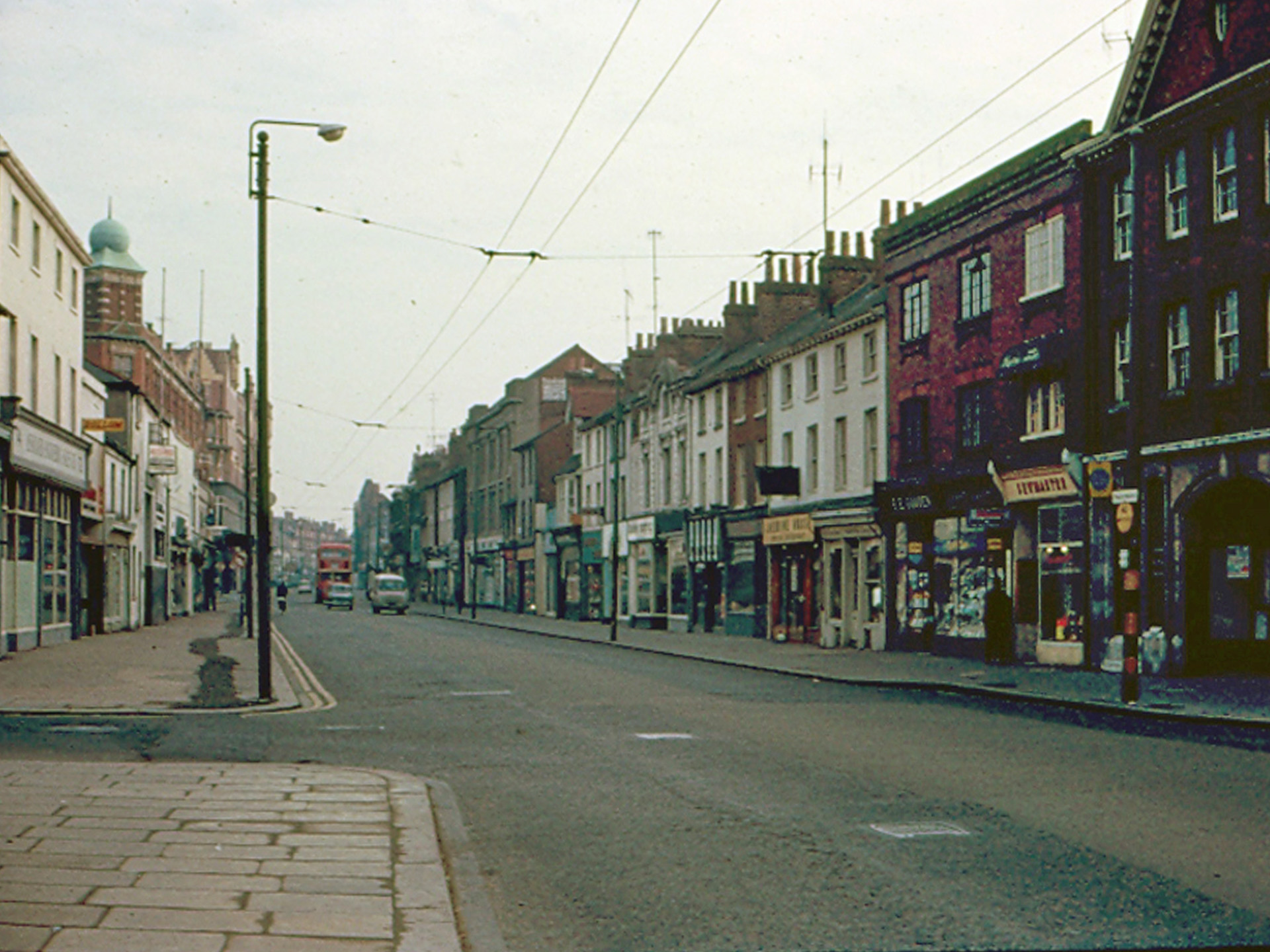
Oxford Road - 1960s
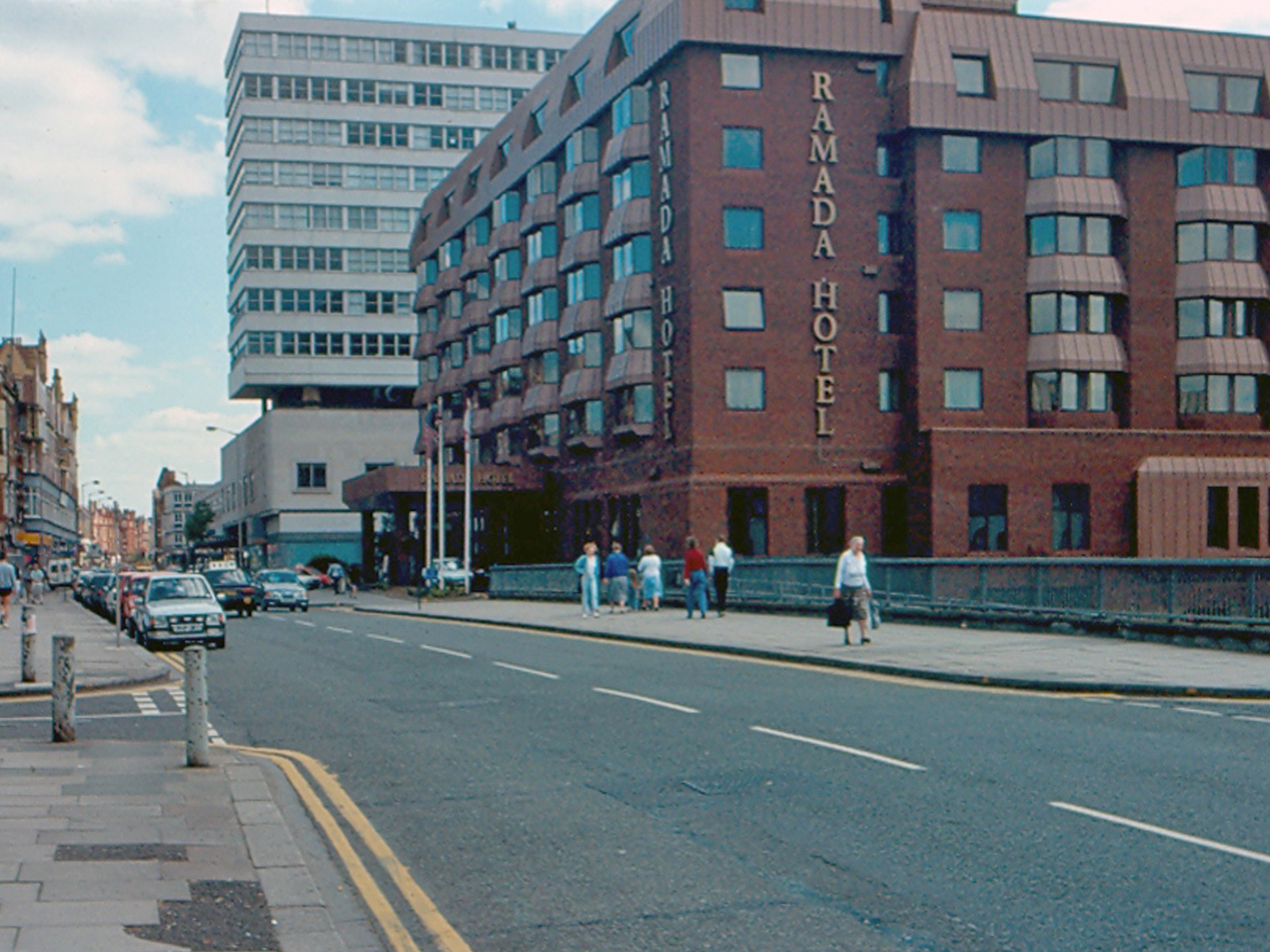
Oxford Road - 1990
On the first slide we saw rows of small houses or shops – a sweet shop, a butcher’s, a cobbler’s, a popular pub and so on – all made even more poignant by the fact that Doug very often knew the names of the residents or shopkeepers. Many showed the overhead cables for the trolley buses that operated in Reading until 1968. But on the next slide, everything was swept away and replaced either by the IDR itself or by large stores, office blocks, etc. In Doug's two pictures (above) the road in the foreground on the left is Alfred St. The IDR passes under the bridge in front of the hotel in the 1990 image. Today (February 2025) the view is much as it was in 1990 except that the Ramada Hotel building is now the Penta Hotel.
Alan showed pictures of St Giles Church, on Southampton Street, which he told us is the point from which all distances to Reading are measured (one for the pub quizzers amongst us). Alan showed a picture of the old power station for the trams before it was demolished (in 1998) to make way for the Oracle shopping centre. He also showed a picture of its carved name plate which is to this day preserved on a wall on the Oracle.
For those of us who remember Reading before the 1960s, this was a hugely nostalgic experience and for those of us who were not in the area then, it was an elegiac glimpse of a particular time and place now vanished. Having said that, I think we also felt that we had seen only half the story because so much has happened between the 1990s and today. Of course, the Hexagon theatre and the Oracle shopping centre still stand but other so-called ‘modern’ buildings have been replaced – the white multi-storey Chatham Street car park for instance. Following its demolition, a new more modern car park was built on the original footprint. Perhaps we need another presentation bringing the Changing Face of Reading up to 2025? How about it, Alan?
January 2025
The Yvonne Arnaud - “A regional theatre with national reach.”- Joanna Read
At the January meeting of the Hartley Wintney u3a the speaker was Joanna Read, the Chief Executive and Artistic Director of the Yvonne Arnaud Theatre in Guildford. Many of us have happy memories of visiting the theatre and wish it well in this, its 60th anniversary year.
As Joanna explained, the Yvonne Arnaud is very much a ‘people’s theatre’. Local people raised the money to build it and it is named for a well-loved local actress. The Grade II listed building has advantages and disadvantages. Designed by John Browning, it is almost entirely surrounded by water - picturesque but liable to flooding. The structure itself is built out of then-fashionable concrete making alterations extremely difficult. On the plus side: the acoustics are excellent and every one of its 586 seats has a good view of the stage.
A second building, the Mill Studio, with 80 to 90 seats is used for educational activities and experimental works. The garden is also sometimes used – English weather permitting.
Unusually for a small regional theatre, the Yvonne Arnaud is a ‘producing’ theatre. That is to say: it creates some of its productions from scratch, notably its popular Christmas panto. But one of its main concerns is community engagement, providing educational and social activities for people in the area from toddlers to lonely pensioners and partnering many local voluntary and statutory organizations. 10,423 people took part in the community engagement program last year!
The powers that be consider Surrey to be a wealthy area and so the Yvonne Arnaud receives absolutely no Arts Council funding. Despite this, with the assistance of just 34 permanent staff members and 100 volunteers, the theatre managed to put on 88 productions on the main stage last year attended by 120,000 people, as well as 39 productions in the Mill Studio. Research shows that Yvonne Arnaud Theatre makes a large positive contribution to the economy of Guildford by bringing visitors into the city centre. About 87% of theatre goers wouldn't have visited Guildford if they'd not been going to the theatre.
As Joanna’s talk ended, we were interested to hear that the Yvonne Arnaud is said to have two ghosts and definitely has two dogs!
December 2024
A Passion for Puppets - Peter Beaven
Did you own a Pelham puppet as a child? If you did and, if it’s still lurking somewhere in the attic, you could be in luck. Collectors will pay as much as £3,000 for one of the rarer models.
One of the keenest of those collectors is Peter Beaven, who spoke at our u3a monthly meeting.
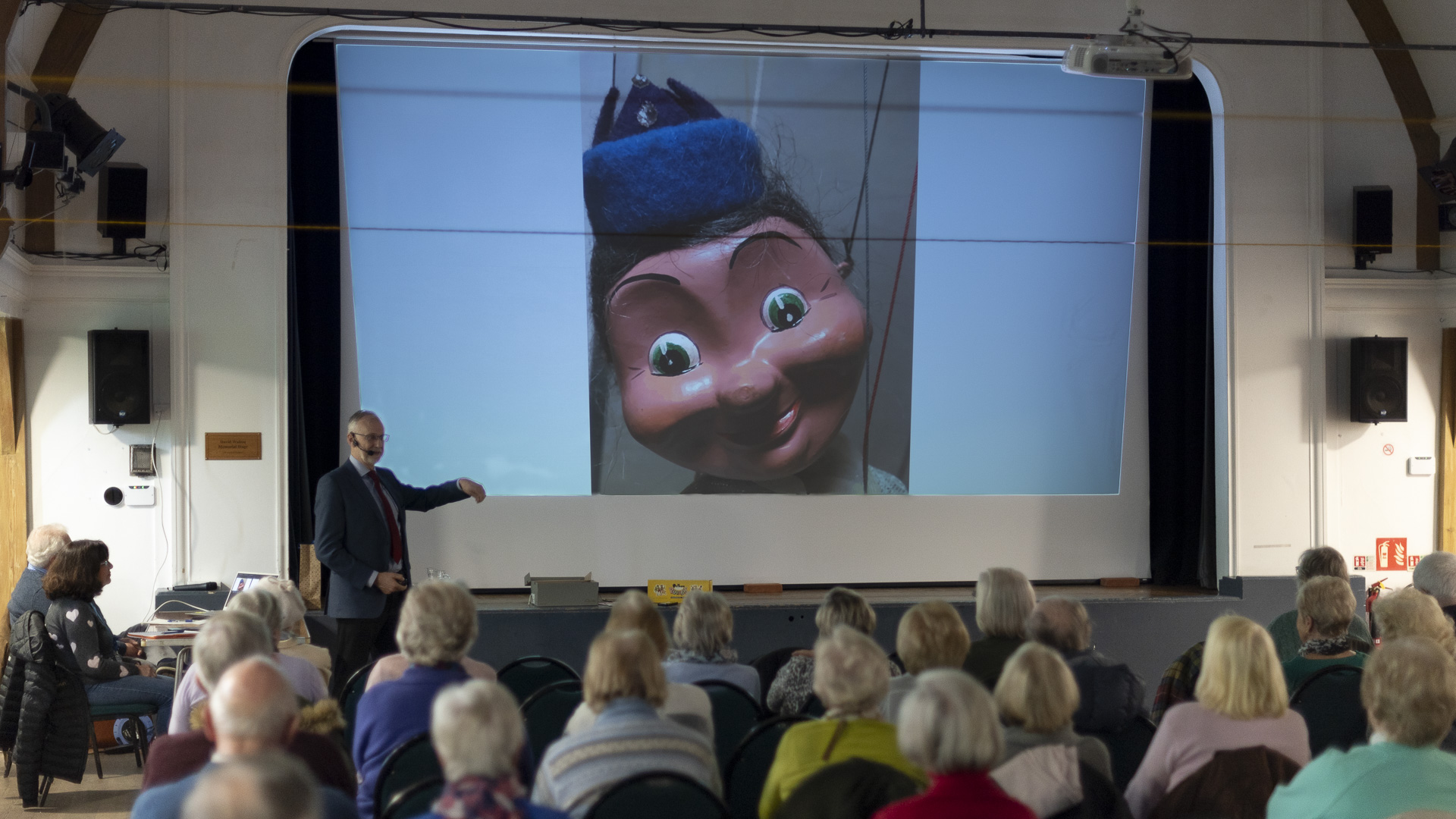
Peter addressing a packed Victoria Hall on 3 December 2024.
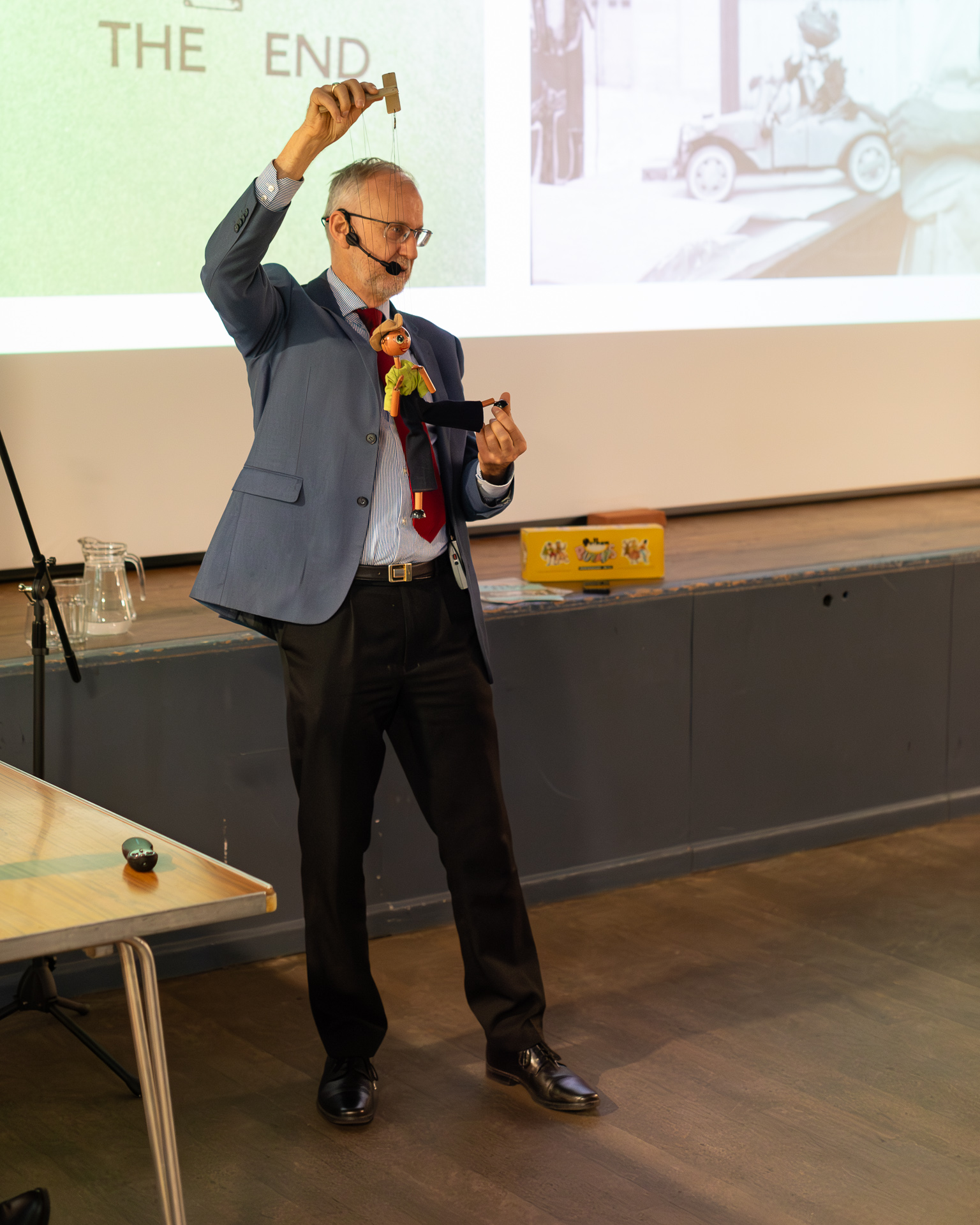
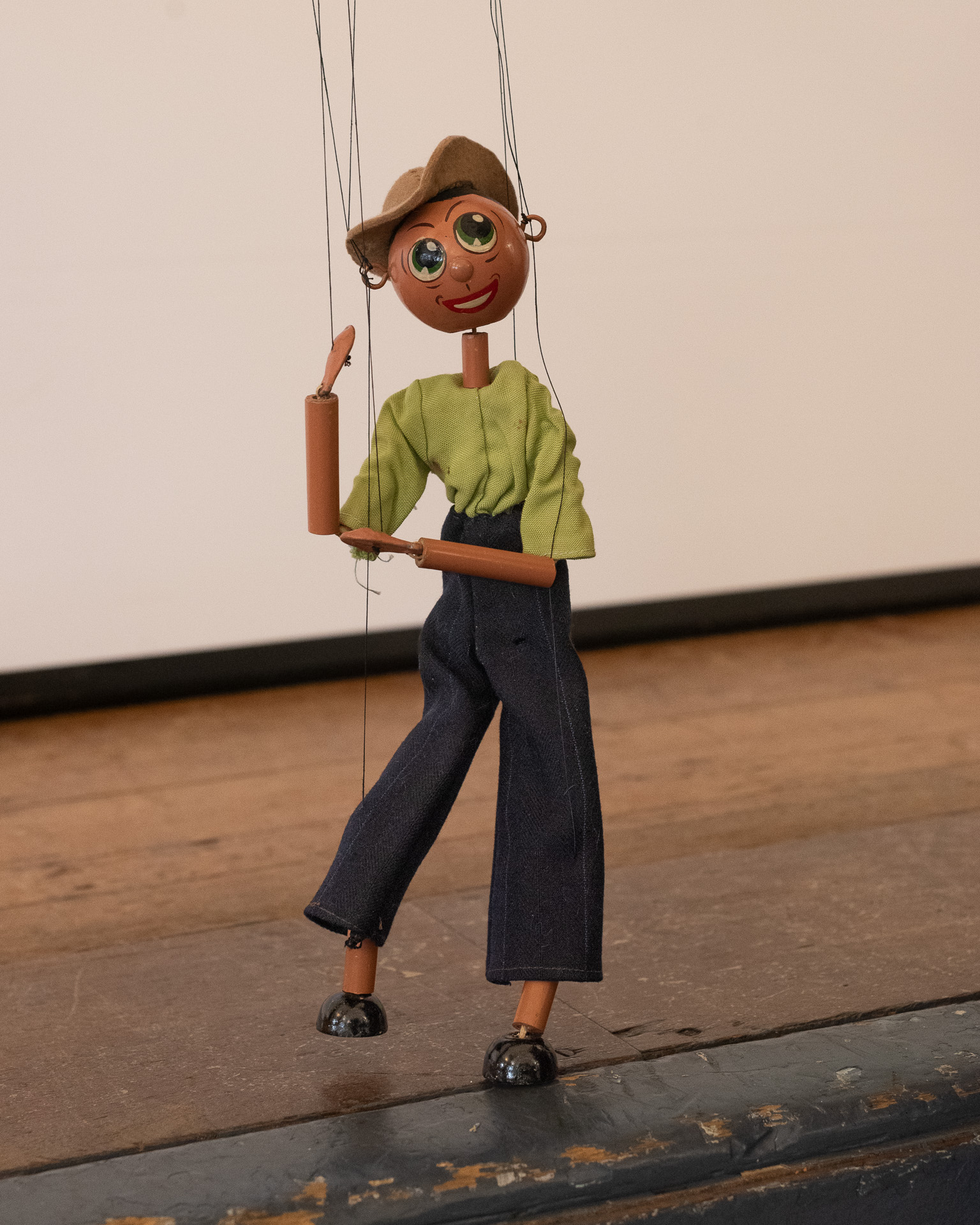
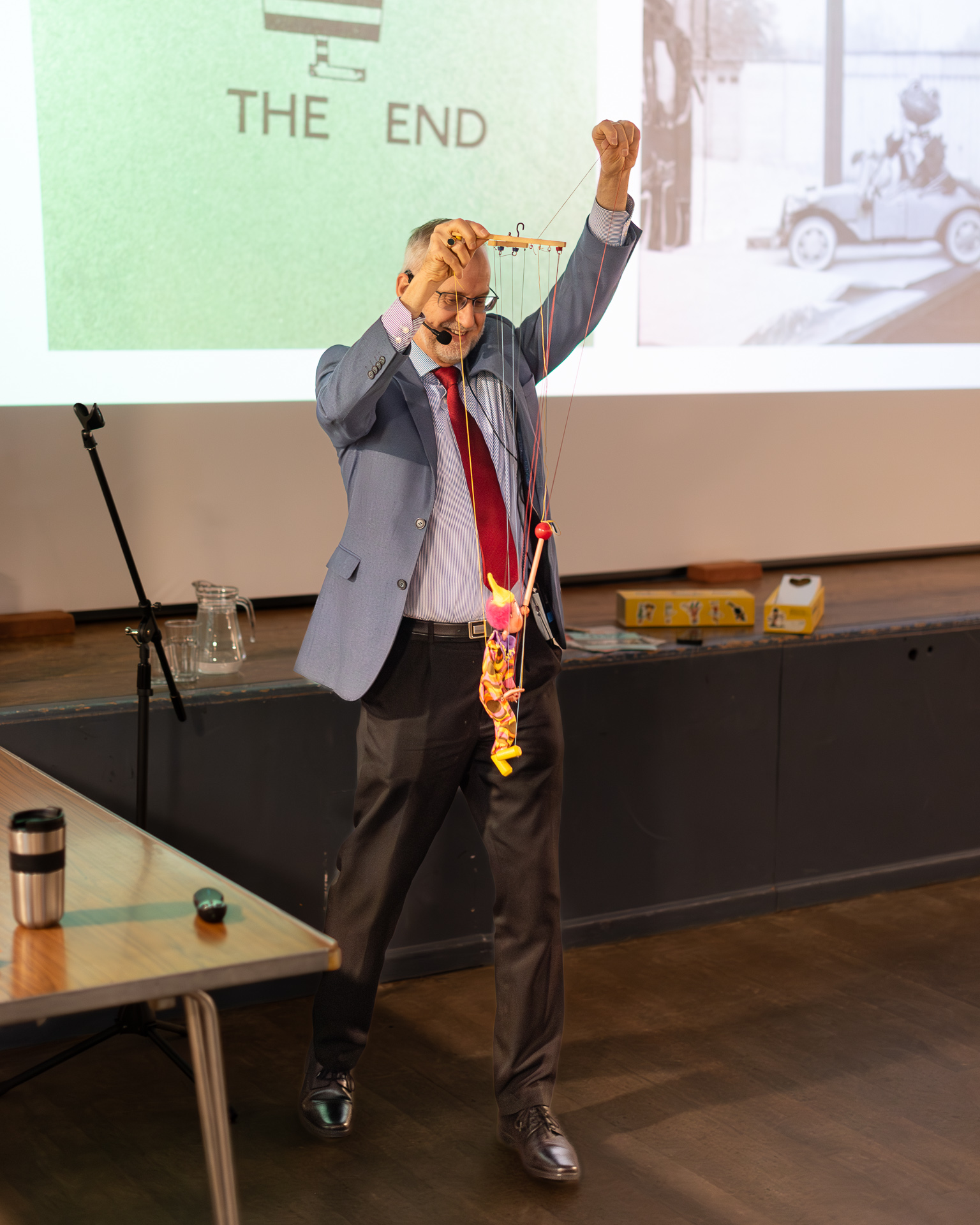
Since taking possession of his first Pelham puppet as a birthday present at the age of 8, a handful more then followed. By the time Peter left home for college, his childhood toys had been relegated to the attic. A few years later, these puppets emerged from the darkness, to perform at a young niece’s birthday party. Once again, our speaker was ‘bitten by the puppet bug’!
Peter has since accumulated a truly amazing collection – not only of puppets but also of the components that went into their making: moulds for forming heads and hands and so on. He has also spent years trawling through archives and interviewing the people close to Bob Pelham, including his widow.
His research into the history of these post-war toys has also expanded. As a result, he was able to give us a fascinating picture of Bob Pelham’s career.
Bob’s architectural studies were halted by WW2, when he served in North Africa and earned himself a medal, the North Africa Star. After the war, he decided that Architecture wasn’t for him and began making – and selling – small toys that he called Wonky Donkeys. These were little jointed animals that collapsed in a heap when you pressed the base. Unfortunately, unknown to him, the mega toy firm Triang had patented the idea worldwide.
Bob had to think again and what he thought was ‘puppets’. To make them, he used whatever came to hand. For example: army surplus toggles became puppet feet while ammunition box partitions were cut up for puppet torsos.
Every puppet was made by hand – no mass-production here – and even when a factory was opened to meet demand, much of the work still took place in people’s homes. Pelham puppets became so popular that a significant proportion of Marlborough residents was employed in their making.
Sadly, Pelham puppets are no longer being made which makes those that survive even more precious.
Peter is using his unique knowledge of Bob Pelham and his puppets to write a book but don’t hold your breath: he’s been working on it since 1995! In the meantime, we were privileged to be able to share this very British success story.
Peter and his collection have appeared on Collectors’ Lot (C4, 1998), Collectaholics (BBC2, 2015) and Bargain Hunt (BBC1, 2023).
November 2024
A treat for perky pensioners! - Joyce Warrell
This year’s AGM took place on Tuesday, November 5th at the Victoria Hall and, unlike last year’s, it was packed out: the car park full and volunteers bringing more chairs to accommodate the crowd. Once the day’s business was completed, that crowd was rewarded with a delightful entertainment from Joyce Warrell.
Joyce is a charming lady and an accomplished poet. She explained that, when she turned 78 (but still feeling like 23!) she was determined not to stagnate but to do something interesting. It transpired that she had a knack for writing verse – verse that her friends couldn’t get enough of. During lockdown she wrote a poem a week.
Before long, Joyce had enough poems to fill a book – a book called: I’m 78 & counting. 101 Poems for Perky Pensioners. * At our meeting, Joyce read some of the poems from her book and some she has written since. Most of them were a humorous look at the problems of getting older, such as untangling the duvet from the washing machine or getting stuck in the bath. They raised many a chuckle of recognition from the audience and enthusiastic applause.
And you know what? The money that Joyce makes from entertaining groups like ours all goes to the Phyllis Tuckwell Hospice!
* Joyce’s book would make a welcome Christmas present for the perky pensioners in your life and it’s available on Amazon.
October 2024
And another thing I meant to say .. Mel Rees
Mel Rees, who stepped in to cover for the scheduled speaker despite having retired earlier this year, gave us a humorous account of his life.
His story started with the theft of £80,000 of his money by an associate, leaving he and his wife completely broke and having to earn money at any possible opportunity. Having had 38 jobs, some concurrently, since he left school, including handing out magazines on station platforms, he later enjoyed a career as a speaker to the ladies of the WI giving up to 240 talks a year and, for the last 20 years, he has been a tour guide at the Hogs Back Brewery. He told us about his experience at Slimming World and his fondness for the BBC weather presenter, Carol Kirkwood, that his wife of 55 years finds rather amusing.
Mel’s zest for life and sense of humour shone through in all his stories and provided us with a very entertaining and enjoyable talk.
September 2024
Wildlife photography - David Bailey
David Bailey gave a fascinating account of his life as a wildlife photographer. David was previously an engineer and moved to a farmhouse in the Brecon Beacons 18 years ago where he planned to photograph bottlenose dolphins. He was awarded Welsh Wildlife Photographer of the year in 2011 and has also worked in television, with a specific focus on wildlife stories.
David explained that the ‘secret’ to capturing the best pictures is not to be a threat to the wildlife and he displayed some stunning pictures of puffins, beavers, rutting stags, otters, foxes and adders!
There were lovely pictures of kingfishers, where the female bird is distinguished by the vibrant colour of their lower beak, and young kingfishers, which can be identified by their black feet which will eventually turn orange.
There were also amazing shots of barn owls hunting during the day due to freezing conditions at night, a kestrel stealing food from an owl in mid air and boxing hares. Hares can be distinguished from rabbits by their longer back legs and their bigger eyes and ears. They can run at 45mph and have a good sense of smell as well as excellent hearing and eyesight.
Examples of David's work, including many of the photographs used in his talk, can be seen on his website.