with Paul Whittle
We had a real treat on Tuesday 6 January 2026. Our speaker, Paul Whittle, has given several memorable talks to Hartley Wintney u3a, most recently in 2023. On this occasion he took us on a 2-week long road trip from Atlanta to New York. Flying it’s only 860 miles but by road it was close to 1,000 miles.
Paul illustrated his travelogue with many photographs and at each stop gave a description of its place and significance in American history.
Georgia
Atlanta
Atlanta was founded 1837 and has a population 5.5 million. Its name originated from the Western & Atlantic Railroad (1847). It became the State Capital in 1868.
Gone with the Wind
Gone with the Wind, adapted from Margaret Mitchell’s only novel (published in 1936 and surpassed in sales only by the Bible), starred Clark Gable, Vivien Leigh, and Hattie McDaniel. All three won Oscars, but due to racial segregation, McDaniel was barred from the film’s premiere, segregated at the Oscars ceremony, and denied burial in Hollywood cemetery after her death because of her race.
Coca Cola
Atlanta is the birthplace of Coca-Cola, invented by Colonel John Pemberton in 1885 as a medicinal tonic made from coca leaves and kola nuts. The drink’s formula was altered during prohibition to remove alcohol and remains secret today. Coca-Cola is now sold in over 200 countries with daily consumption reaching 1.8 billion units; its plastic packaging significantly contributes to pollution. In a publicity stunt during the "Space Cola Wars", Coke became the first soft drink in space aboard the Space Shuttle Challenger.
Martin Luther King, Jr. (1929-1968)
Martin Luther King was born at 501 Auburn Avenue and lived there for 12 years. He was baptized at Ebenezer Baptist Church, where his family were regular members. Key events in his life include:
- 1955: Civil rights leader (bus segregation)
- 1959: Studied Gandhi's non-violent campaigns in India as Nehru's guest
- 1963: Delivered "I have a dream" speech at Lincoln Memorial
- 1964: Youngest Nobel Peace Prize winner
- 1968: Assassinated in Memphis by James Earl Ray (?)
His memorial is an elaborate table tomb inscribed:
“REV. MARTIN LUTHER KING. JR
1929 - 1968
"Free at last, Free at last,
Thank God Almighty
I'm Free at last,"
His wife Coretta died in 2006 and is buried beside him.
Jimmy Carter (1924-2024)
Not the most successful president, a former peanut farmer, in later life he did an enormous amount of good through the “Carter Centre” founded in 1982.
Atlanta Aquarium
Atlanta also boasts the largest US aquarium, fourth largest in World. It holds 11 million gallons of water, houses 500 species in 80,000 exhibits and is visited by 2.5 million people a year.
CNN
CNN's world headquarters are in Atlanta, Georgia, located at the building known as "The Center" (formerly the CNN Center), which serves as the central hub for its global news operations and hosts major production studios.
Paul vividly described his visit there which included a behind the scenes green screen experience – reading a teleprompter is not as easy as you’d think! The studio generated a picture of Paul and his wife as CNN reporters and another of them in the heaviest (only) downpour of their entire trip.
Savannah
Savannah, located in southeastern Georgia on the Savannah River near the Atlantic coast and bordering South Carolina, is the fourth largest container port in the US. Founded in 1733 by General James Oglethorpe, it was Georgia’s first state capital and America’s first planned city, also known as the birthplace of the American Cotton Industry. Famous for its cobblestone streets, historic squares, and antebellum architecture, Savannah is a popular tourist destination. Notable sights include Forsyth Park Fountain, which features emerald-green water during St. Patrick’s Day festivities, and informative plaques, like the one at the Independent Presbyterian Church, which provide historical context for visitors.
South Carolina
Charleston
Enslaved Peoples
Charleston was one of the largest slave trading cities in the US in the 1800s. The area around the Old Exchange Building was one of the most common sites of downtown slave auctions. This makes the site one of the most important in the history of the US slave trade. Along with real estate and other personal property, thousands of enslaved people were sold there as early as the 1770s.
Magnolia Plantation and Gardens
Magnolia Plantation and Gardens, spanning 464 acres on the Ashley River, is one of the oldest Southern plantations. Established in 1676 by Thomas and Ann Drayton, it became gardens after falling into disrepair post slavery abolition. The Drayton family has owned it for 15 generations.
Fort Sumter
In January 1861 Confederate shore batteries fired on the unarmed ship 'Star of the West’. The siege of Fort Sumter began on 12 April 1861 when 3,300 shots were fired at the fort. There were no casualties, but shortage of water, food and ammunition compelled evacuation by sea on 14 April. Today statues in the grounds commemorate the Confederate Defenders of Charleston Fort Sumter, but given the links to slavery they are now controversial.
North Carolina
Wilmington
Wilmington, located on the banks of the Cape Fear River, was a major Civil War naval base for the Confederacy. This continued into the twentieth century when “Liberty Ships”, a class of cheap to build cargo ship, were built by the United States during World War II under the Emergency Shipbuilding Program. 250 were built at Wilmington between 1941 & 1945.
Today Wilmington's Riverwalk, which stretches 1.75 miles along the bank of the Cape Fear River in historic downtown Wilmington, has been named in the top 10 riverwalks across the country by USA Today. Wilmington still has a naval connection, Paul showed us a photograph of the battleship USS. North Carolina moored on the river.
Virginia
Richmond
Richmond is only 108 miles south of Washington DC. It has a population of 240,000 and has been the State Capital of Virginia since 1780. In 1788 the State Capitol was built, it’s a copy of the Maison Carrée, a roman temple, in Nimes France. It houses the oldest legislative body in the Western Hemisphere. The Virginia General Assembly (1619).
Civil War
Richmond had huge significance during the Civil War because it was located on a bend of a navigable river and was the point where several railway lines crossed running both east-west and north-south. The Tredegar Iron Works (built in 1837) was the biggest ironworks in the Confederacy during the American Civil War, and a significant factor in the decision to make Richmond the Confederate capital. Yes, that is Tredegar as in South Wales – many US settlements were named by the early immigrants from Europe after where they had come from. In 1861 the works had 900 workers including 450 slaves, some of whom had very responsible positions.
Richmond fell on 2 April 1865. At the time the house owned by Wilmer McLean was the location of the surrender conference for the Confederate army of General Robert E. Lee on April 9, 1865. Later McLean said, "the war began in my back yard and ended in my front parlor". Despite the huge destruction the Tredegar Ironworks survives today and is now a museum.
The Human Cost was enormous the total deaths in battle or by disease were USA. 360,000 and C.S.A. 260,000. The total wounded on both sides was 471,000. To put that into perspective it’s more than the total number of US casualties in World War I and World War II combined.
Tobacco
In more recent times between 1910 & 1981 Lucky Strike cigarettes were made in Richmond by the American Tobacco Company. In the 1940s it was the world's biggest cigarette plant producing 100 million cigarettes per day. Its contribution to lung cancer deaths cannot be overstated! Another impressive building Paul showed us - Richmond’s Main Street Station, built in 1901, is a historic railroad station and office building. You enter at street level and go up several floors inside the building to reach the platforms. Paul had stayed in the Jefferson Hotel (1895) which is claimed to be the finest hotel in town. The hotel's iconic grand staircase is widely believed to have been the inspiration for the mansion staircase in Gone with the Wind. It also famously housed live alligators in its Palm Court marble pools.
Jamestown
Jamestown was the first permanent English settlement in the Americas.
Pocahontas, a Powhatan girl (c. 1596-1617), was key to early Jamestown relations, befriending settlers, warning John Smith, and bringing food, later converting to Christianity, marrying tobacco planter John Rolfe (as Rebecca), and traveling to England as an ambassador before dying young in England.
Williamsburg
Williamsburg was founded in 1632 and was the State Capital of Virginia from 1699 to 1780. Colonial Williamsburg is a living-history museum in part of the historic district in Williamsburg. Its 300-acre historic area includes several hundred restored or recreated buildings from the 18th-century. The district also includes 17th-century, 19th-century, Colonial Revival, and more recent structures and reconstructions.
Monticello
Monticello is a UNESCO World Heritage Site because it's a masterpiece of American neoclassical architecture, designed by Thomas Jefferson (1743-1826), the primary author of the Declaration of Independence 1776 "All Men Are Created Equal". He was the third US President, 1801 – 1809.
His contradictory relationship with slavery, makes it a crucial site for understanding early American history, culture, and design. "All Men” may be “Created Equal" but in Orwell’s words some are more equal than others. Jefferson owned 5,000 acres and 400 slaves for whom life was very tough. After his death his estate was put up for sale it consisted of “130 VALUABLE NEGROES, Stock, Crop, etc. Household and Kitchen Furniture.” The advert continued “The negroes are believed to be the most valuable for their number ever offered at one time in the State of Virginia.”
The Skyline Drive
Paul’s trip continued along The Skyline Drive, a famous scenic byway known for stunning views, along the crest of the Blue Ridge Mountains, it runs the entire 105-mile length of Shenandoah National Park. The road was constructed as a public works programme, in the 1930s.
Washington DC
Washington DC became the US capital after the Residence Act of 1790 established it as the permanent seat of government along the Potomac River, with President George Washington choosing the exact site, and Congress moving there permanently in 1800, after Philadelphia served as the temporary capital from 1790-1799.
Here's a timeline:
- 1790 (July): Congress passed the Residence Act.
- 1790-1799: Philadelphia was the temporary capital.
- 1792: Construction began on the President's House (now the White House).
- 1800: The government officially moved to Washington, DC, with President John Adams being the first to live in the White House.
In Washington DC, the "DC" stands for District of Columbia, a special federal district created as the seat of the US government, separate from any state, named partly after Christopher Columbus (Columbia).
The National Mall
The National Mall is a large green area in Washington DC stretching from the US Capitol to the Lincoln Memorial. It features the Washington Monument, Reflecting Pool, several museums (such as the Smithsonian). Arlington Cemetery, across the Potomac River, with war memorials for veterans of WWII, the Korean War, and Vietnam, is reserved for military burials and includes President John F. Kennedy's grave. The White House sits north of the Lincoln Memorial.
The Smithsonian
The Smithson was founded is 1836 as a Trust of the US Federal Government under the will of James Smithson (1765 -1829) his first heir having no children.
It consists of 21 Museums, 21 Libraries, 14 Education and Research Centres, and a zoo. It also has 200+ Institutions and Museums in 47 States, almost all of which have free entry.
Library of Congress
The Library of Congress was founded in 1800; it contains 26 million books, has 3,000 staff and a total of 173 million items.
Dutch Country and the Amish
"Dutch Country" in the US primarily refers to South Central Pennsylvania it’s known for its Amish and Mennonite communities and rich German heritage (the "Dutch" comes from "Deutsch"). The Amish speak a German-based dialect.
Today there are approximately 300,000 Amish in 500 settlements across US and Canada. In the 1720s and 1730s, they emigrated from Europe to escape persecution, motivated by the pursuit of religious freedom and opportunities for land under William Penn's policies of tolerance. A subsequent migration occurred in the mid-19th century.
They wear plain clothes, worship in houses not churches and choose their own leaders (Bishops). The lack of any hierarchy means that the Bishop in one area can contradict a neighbouring Bishop. Paul speculated that this was diluting the Amish way of life and wondered how much longer they would survive as a separate sect.
They have no mains utilities in their homes, cars, tractors, TV or radio. However, they do pop into their cow sheds, which use electricity for agricultural purposes, to charge their mobile phones!
The horse-drawn buggy is essential to Amish society. Amish buggies are both practical transport and symbolic of the people. Being give their own buggy, at 18, is a rite of passage for young Amish men. Some customise their buggies adding varying degrees of comfort and technology.
Philadelphia
Philadelphia is known as the "birthplace of America" because it was the central location for crucial events during the nation's founding.
- William Penn (1644-1718) founded Pennsylvania and its capital, Philadelphia, in 1682, envisioning a "holy experiment" for religious freedom, designing the city with a grid plan and open spaces for growth. Penn's vision for a planned, open city with equitable governance heavily influenced Philadelphia's early development and his ideals of liberty and community remain central to the city's identity.
- Benjamin Franklin (1706–1790) was an American polymath: a writer, scientist, inventor, statesman, diplomat, printer, publisher and political philosopher. He was a successful newspaper editor and printer in Philadelphia. He was one of the Founding Fathers of the United States; a drafter and signer of the Declaration of Independence; and the first postmaster general.
Declaration of Independence
The Declaration of Independence was primarily written by Thomas Jefferson with input from the Committee of Five (Adams, Franklin, Sherman, Livingston) and revisions by the Continental Congress, which convened in Philadelphia on 10 May 1775. This time it met in the Pennsylvania State House, or Independence Hall, as it is now called. It was in this building that the Declaration of Independence was signed formally adopting the final text on 4 July 1776.
The city's rich history includes many other American "firsts", solidifying its foundational role in the United States.
- 1731 First Library
- 1751 First Hospital
- 1775 First National Capital
- 1765 First Medical School
- 1784 First Zoo
- 1790 First Stock Exchange
However, Philadelphia Cream Cheese originated in New York, not Philadelphia. The name was added by distributor Alvah Reynolds in 1880 to leverage Philadelphia's reputation for high-quality dairy, making it a marketing success.
New York
The land was claimed by the Dutch in 1609 who then bought the island of Manhattan in 1626 and called it New Amsterdam. It was captured by British in 1664 and renamed New York.
The are many iconic skyscrapers including the Flatiron (1903). The more famous Empire State Building was completed 1931; it’s 1,250 ft, 102 storeys and has 4 million visitors per year. It was famously ascended by King Kong “The Eighth Wonder of the World” in the 1933 movie.
Central Park
Central Park opened 1858 it occupies 800 acres and has 40 million visitors per year.
Strawberry Fields
Strawberry Fields is a memorial to John Lennon who died on 8 December 1980 after being shot by Mark Chapman. It consists of a five-acre landscape near the West 72nd Street entrance and includes the Imagine Mosaic.
9/11
On 11 September 2001 the Twin Towers of the World Trade Center, collapsed after terrorists flew a hijacked commercial airplane into each one. The shorthand “9/11” arises because, unlike almost every other country, the United States uses the M-D-Y (month, day, year) date notation. It’s infamous as the single deadliest-ever terrorist attack – killing 2,977 and injuring 25,000 people. The damage caused was $10 Billion.
343 New York firemen died whole trying to save those trapped in the towers, Paul showed us a picture of the very impressive memorial to them. Today there are two pools where each building once stood and a single new tower “One World Trade”, opened in 2014.
Grand Central Station
The Grand Central terminal was considered the world's largest train station by number of platforms and area when it opened in 1913, a title it still often holds for its massive size (49 acres, 44 platforms, 67 tracks) and iconic Gilded Age architecture.
Paul then showed two contrasting photographs of the New York Central Railroad the first in its heyday 1934 and the second sometime between 2009 and 2014 where trees are growing between the sleepers of the long-abandoned track.
Statue of Liberty
Statue of Liberty (Liberty Enlightening the World) opened in 1886. The French people funded the statue itself, while the American people funded the pedestal through a massive crowdfunding campaign led by newspaper publisher Joseph Pulitzer. Perhaps one should not forget that the American people had a “special relationship” with the French before the English.
Governors Island
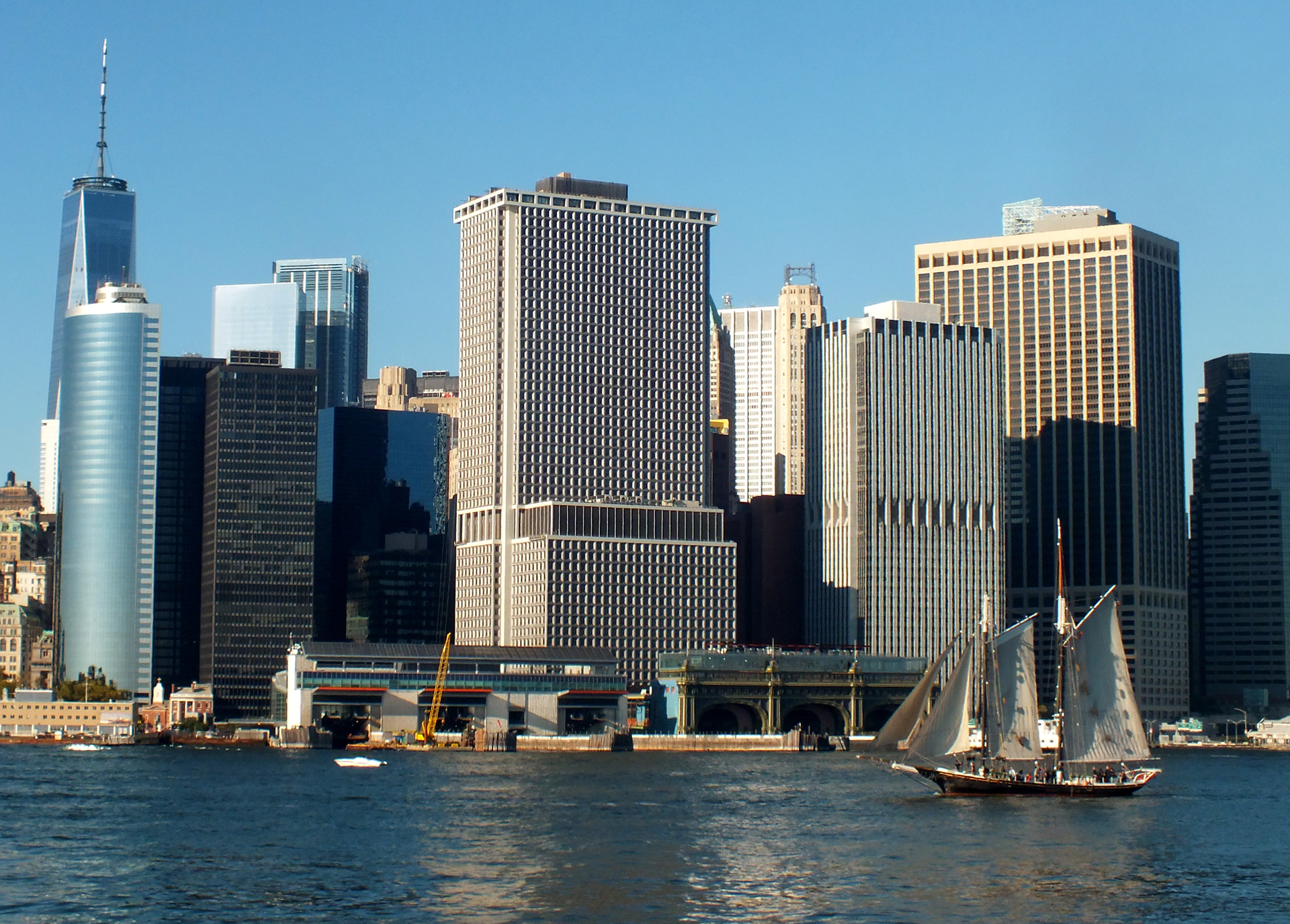
Governors Island has a rich history as a vital military installation for over 200 years, and important role in early NYC development. It’s been transformed into a unique public space for recreation, arts, history, and environmental education, offering stunning views of Manhattan, one of which Paul showed us to end his talk. He was particularly pleased with this photograph because it shows a sailing ship which just happened to come along at the right time.
6 January 2026