The Post Office has had some bad press lately, but it is the lifelong passion of John Rogers, and he shared that passion with u3a members at our meeting on Tuesday, 6th October, at the Victoria Hall.
We take the Royal Mail for granted, but it hasn’t always been around, being established just five hundred years ago, although prior to 1635, only certain institutions and the elite could use this service. After that, it was open to everyone – but at a price. The siting of the first post offices usually followed the routes of the mail coaches, and some main highways still follow those routes today.
The first post offices as we understand the term were opened in 1659, including those in Reading, Newbury and Basingstoke, and, unusually for the size of the settlement, Hartfordbridge, which eventually led to Hartley Wintney Post Office opening in 1891.
Over the years, of course, there have been many changes. Initially, postage was paid on receipt of the item, but people became wise as to how to include hidden messages on the outer cover such that the recipient saw what was being communicated and so refused to pay for the item.
The Post Office, and therefore the Government, started to lose money as a result, so a new system was needed. Enter Rowland Hill, who invented the postage stamp in 1837 and the Universal Penny Post in 1840, which introduced a UK-wide pre-paid rate of 1d, thereby transforming the postal system. His reforms made mail accessible to almost everyone in Britain, greatly increasing both mail volume and Post Office profits. Thanks to Hill’s innovative invention, UK stamps are uniquely without country-of-origin. The rapid growth in mail usage prompted changes in how letters were posted, collected, and sorted.
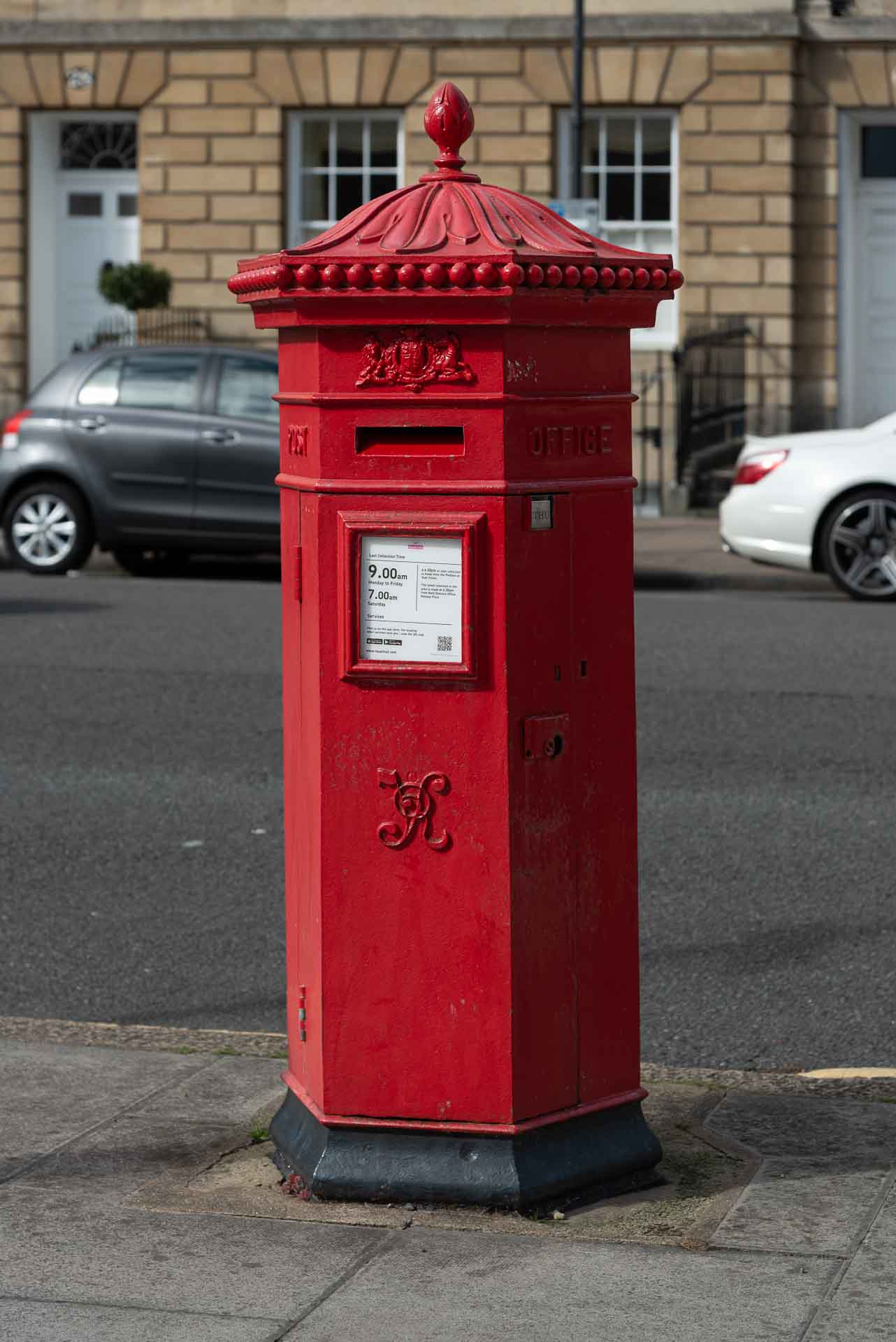
The famous novelist Anthony Trollope recommended the introduction of letter boxes, which happened in 1854. By 1887, there were post boxes everywhere, either set into walls or as free-standing pillar boxes. John showed us a picture of this box.
Left: A Victorian pillar box in Great Pulteney Street, Bath. Photo © Peter Johnson
There are thousands of letter boxes across the UK, each bearing the cypher of the monarch in power when it was installed. Old boxes remain in use, so a variety of royal cyphers can be seen, including rarer Edward VIII examples. In Scotland, pillar boxes do not feature ‘EIIR’ as Elizabeth II was not regarded as the second Queen Elizabeth there, since Elizabeth I was only Queen of England and Wales. After objections when the first Elizabeth II cypher boxes appeared in Scotland after 1952, a new design featuring only the Scottish Crown was adapted for Scottish post boxes, a tradition that continued throughout Elizabeth II’s reign.
The nineteenth century was the age of the train, and trains criss-crossed the country carrying mail: most with letters being sorted enroute in the Travelling Post Offices (TPOs). John had travelled on one of the last TPOs from Paddington to Penzance and showed many photographs; just imagine standing all night on a train doing 100 mph and sorting mail! The postmen were put up in a hotel after night duty. TPO trains stopped being used in 1996. There was a Post Office Underground railway in London which helped to move the mail from main line termini to main Post Offices, but as mail mechanisation was introduced, practices changed with Willesden the hub of mail operations, such that MailRail, as it was called, ceased operations and became a tourist attraction.
Royal Mail processing centres are now huge and fully mechanised, serving a large area. Machines sort, cancel stamps, and add code marks containing all the relevant delivery information to letters. This means that up to 50,000 items per hour can be processed. The only human input tends to be necessary with problem mail or delivering it. Today, if you post a letter to your next-door neighbour, it will be collected, taken to Swindon, which is the nearest mail processing centre, and then returned to Hartley Wintney for delivery.
Stamps, Parcel Post, and picture post cards are some of the innovations that our country has given to the world via the Post Office.
In its glory years, the Royal Mail offered same-day delivery, but then it had no competition. Today, there is the internet and WhatsApp. Royal Mail now handles more packets and parcels than letters. Many Post Offices have closed. Sunday collections ended several decades ago, and now the frequency of weekday deliveries is also threatened, particularly in remoter areas, whilst second-class letters will probably not be delivered every day, though some parcels may be delivered on Sundays.
The Post Office has a glorious past. John Rogers, for one, hopes that it will have a viable future.
October 2025