1
In the Year of our Lord 1535, two men travel the length and breadth of the county of Southampton visiting religious establishments at the command of Thomas Cromwell, the Principal Secretary to the King and Vicar-General.
Dr Thomas Legh and John ap Rice are charged with investigating the fifteen monasteries in the county and assessing the quality of their religious life, whether they indulge in the veneration of religious relics and investigating and reporting on any moral laxity.
In truth, they are seeking reasons to suppress the monasteries and seize their buildings and lands for King Henry.
2
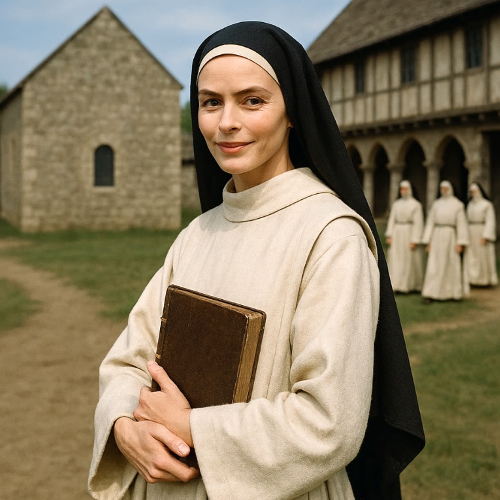
At the north-east corner of the county, in a peaceful backwater surrounded by farmland and marshes, the nuns of the Priory of St Mary Magdalene, Wintney, go about their business. Theirs is a small establishment – a group of ten nuns including their prioress, supported by lay brothers and sisters.
They have sheep and cultivated land around the priory. Further afield they have property in Winchester City and a farm at Herriard.
It is early September, autumn is coming and there is a chill in the air as the bell sounds for morning Mass. The nuns make their way to the small stone chapel. John Bansal, the priest from St Mary’s Church, is in attendance as women are not permitted to deliver the holy sacrament of bread and wine. The thick smell of incense fills the small chapel.
Despite their limited numbers, the chants of the psalms and canticles are loud and clear, only to be heard by a few labourers and a flock of sheep.
After the service, the nuns file to the adjoining Chapter House. There are readings from a chapter of the Rule of St Benedict and the entry for the day in the Martyrology – a large, revered book of words some three hundred years old.
After the readings, Elizabeth Martin, the prioress rises to speak. She is twenty three years old but, despite her young age, she speaks with authority – and with warmth.
‘My sisters in Christ, as you will be aware from my previous announcement, we will shortly have a visitation from two of the King’s commissioners.
They are to examine the conduct of our religious affairs and how diligently we follow the Rule of our Order and whether we have committed any transgressions – spiritual or temporal.
Sisters, I am confident that the conduct of our priory is beyond reproach and that, as a consequence, the commissioners will have nothing adverse to report. I ask you therefore to co-operate fully with our guests and show them the courtesy due to any visitor to our priory. Remember that they may be sent by Secretary Cromwell but they come in the name of the King.’
Sister Elizabeth concludes with a blessing and retires to her room on the other side of the priory accompanied by her deputy, Agnes Pine.
Elizabeth confides in Agnes. ‘I have concerns about this visit, sister. In Winchester there is talk about our Master Cromwell. There is talk of him seizing the monasteries, stripping them of their assets and lining the King’s coffers.’
Sister Agnes looks at Elizabeth. ‘You should be in a better position than anyone to know of Mister Cromwell’s plots. With your contacts in high places…’
‘Sister, I know it is Thomas Cromwell who appointed me to this position. I also know that, after many years of faithful service as sub-prioress, you had the right to think you would be elected to the position I now hold by the grace of God.’
‘And the grace of Secretary Cromwell…’ adds Agnes pointedly.
‘Let me be clear, Agnes, Master Cromwell may have appointed me, but I hope that by God’s will I have been diligent in my service to this Priory, its nuns and to God himself. I will continue to serve this monastery and its sisters and brothers to the best of my capacity for however long or short that might be.’
‘I fear we may be a lost cause, sister,’ adds Agnes. She looks perplexed and sighs. ‘Let us pray that the commissioners find nothing of reproach here.’
‘I’m confident they won’t,’ says Elizabeth. ‘I have heard no stories of impropriety and no sisters that are discontented with their life here. And, while I think of it, the commissioners’ visit is on a Friday, perhaps you could have a word Sister Beatrice to ensure the stew pond has a stock of fish for that day. We must make sure no meat is eaten by anyone, anywhere or for any reason on that day. Now, I must see Brother John Mark about some sheep.’
3
It is just after 6 o’clock on the morning of Friday 24 September. The two commissioners, Dr Thomas Legh and John ap Rice, set out from The Lamb Inn in Hartley Row.
The sun has barely risen; the air is cold and damp. The balding trees herald the coming of winter.
They set off along the Odiham Road then turn off and make the climb towards St Mary’s Church. The aspect is a mixture of marshland and farmland with small holdings each side of the road.
The church itself stands prominently with the priest’s house on the opposite side of the road. Around are the handful of cottages that make up the village of Hartley. The two men pause at the church and look at the simple whitewashed building. They do not venture inside; their remit does not extend to the church, even if it is owned by the Priory nuns.
From the top of the hill, the two men can see the Priory down below them, some half mile distant.
They arrive at the gatehouse. As custom – and Chapter 53 of the Rule of St Benedict - dictates, they are welcomed warmly by the Prioress herself, a short prayer is said and she gives them each a kiss of peace.
Thomas and John accompany Elizabeth to her lodging. As befits a Cistercian establishment, her quarters are unpretentious – Spartan even. There is a smell of lavender in the room and a small wooden cross rests on a large wooden document chest. The guests are offered wine but decline – it is too early in the day.
After some pretence at courtesy – Elizabeth saying how she welcomes their visit, how much they wish to co-operate with the commission and so forth – they get down to business.
Dr Legh begins. ‘We are here to determine the quality of religious life here. And we are particularly charged, sister, to find out about any superstitious religious observances – the veneration of relics and such abominations. We shall also enquire into any impropriety with the community and any evidence of moral laxity.’
John ap Rice adds ‘We shall be interviewing each of the nuns and some of the lay brothers and sisters who work here. And following previous visitations, we are also charged to inspect the fabric of the priory.’
As the men are ready to go, Elizabeth stands up. She may be young but she has a presence and bearing that impresses John at least. ‘To work then, gentlemen. I shall introduce you to our sub-prioress, Sister Agnes, who will escort you on your business. I will await your report at the end of the day. If you have need of me, I shall be here – at your disposal.’
The men take their leave with due civility. She breathes a sigh of relief and prays to Almighty God.
The men set about the task of interviewing the nuns and such of the lay brothers and sisters as they think fit. They inspect the buildings under the watchful eye of Sister Agnes.
They have fish for lunch – no meat – and interview Elizabeth herself after lunch. For their part, the nuns continue their own activities and attend the daily services in the chapel.
It is early evening before the two commissioners return to the prioress’s lodgings. This time they take wine with Elizabeth who awaits their summary of the day’s proceedings. After some social preamble, Thomas Legh outlines their main findings.
‘Firstly, let me thank you and your sisters for your hospitality and co-operation,’ he says, standing to give his words more gravity. ‘We find all the sisters to be of good reputation and diligent in their duties to the convent, both spiritual and temporal.
‘As for the fabric of the convent, the church and main buildings are of good repair, save the tiling needing some attention. However, as you are aware, I find the kitchen and brewhouse in poor condition. And you yourself admit the convent has no money for the necessary repairs.’
With that, the two men take their leave.
4
It is March in the year 1536. Parliament has passed the Act for the Dissolution of the Lesser Monasteries.
“FORASMUCH as manifest sin, vicious, carnal and abominable living is daily used and committed among the little and small abbeys, priories, and other religious houses, whereby the governors of such religious houses and their convent, spoil, destroy, consume, and utterly waste, as well their churches, farms, lands, tenements, the ornaments of their churches, and their goods and chattels, to the high displeasure of Almighty God, and to the great infamy of the king's highness and the realm, if redress should not be had thereof.”
Elizabeth Martin is outraged as she reads the preamble to the Act.
All religious establishments with an annual income of less than two hundred pounds are to be closed. Wintney Priory is therefore condemned.
At the daily Chapter Meeting, she tells the sisters, ‘Given the exemplary report from the King’s Commissioners in September last, I have visited Bishop Stephen to petition him on our behalf. I have also sent a similar plea to Master Secretary Cromwell himself.’ She ends with reassurance. ‘Above all, sisters, do not despair, for God loves us and delights in us and all shall be well.’
Elizabeth leaves the meeting and retires to her quarters where she sits and weeps. They are tears of sorrow, frustration and helplessness.
5
It is Saturday 22 July in the Year of Our Lord 1536. It is the Feast Day of St Mary Magdalene, the patronal saint of Wintney Priory.
But there are no celebrations. Today is the day that Wintney Priory closes its doors. The King’s men are already securing the property, checking off the assets against their inventories – making sure that no one is leaving with anything to which they are not entitled.
The mood is sombre as the sisters and brothers assemble outside the priory gates. It is summer but the sun does not shine.
The nine nuns, excluding the Prioress, will make their way to a larger Cistercian nunnery in Dorset. They take a mule and cart with them and their few belongings.
As is the practice, the prioress, Elizabeth Martin, will not go with them. She will go to Wokingham where she has relatives and will lead a more secular life. She has a horse and some personal items – a small prayer book, two rings and a small silver bowl. She has been granted an annual pension of ten pounds from the King and a lump sum by way of alms. As the party moves silently away, she does not look back.
They reach the entrance to the church of St Mary’s where local villagers and farmers have come to wish the sisters farewell.
They regret the passing of the nunnery – it was the nuns who tended to the sick and gave basic reading and writing lessons to their children. The priory is now the King’s possession; will he be tending to the villagers’ needs?
Before the nuns move on, Elizabeth offers a prayer to the people and finishes with a blessing.
As they descend the hill from the church, a soft summer breeze kicks up dust from the road. The party divides when they reach the Great Western Road - Elizabeth eastwards, the other nuns westwards.
Elizabeth embraces each of the nuns: the two youngest, Sisters Lucy and Joanna – in their late teens and to whom she whispers advice – then Sister Felicia, the kitchener: Christina, the precentrix; Rosa, the almoner; Beatrice, the cellaress; Emma, the sacrist; and finally, Agnes, the sub-prioress. The embrace with Agnes is a warm one from Elizabeth but is not fully reciprocated.
Elizabeth barely holds back tears as she prays for them, finally telling them to ‘Go in peace to love and serve the Lord.’ To which they respond, ‘In the name of Christ, Amen.’
At the Priory, the great door is finally shut - locked and bolted. Behind it, muted whisperings can be heard. Is it the summer breeze through the cloisters or the voices of former nuns recounting the life of a monastery that once was?
The End
Notes
Elizabeth Martin’s annual pension of £10 equates to £120,000 today (Measuring Worth website, taking income relative to income of average worker). She lived until 1587, some 51 years after the closure of the Priory.
The Wintney Calendar and Martyrology, which contains a feminised version of the Rule of St Benedict and an ecclesiastical calendar, dates back to the year 1200 and is now in the British Library.
St Mary’s Church was replaced for regular services by St John’s Church in Hartley Wintney in 1870 and is now managed by the Churches Conservation Trust.
The names of the two commissioners, Stephen Gardner (the Bishop of Winchester), Thomas Cromwell, the priest from St Mary’s and the prioress are real. All other names are fictitious.
Reference Material
Hampshire Nunneries Diana K. Coldicott Phillimore & Co Ltd
The Dissolution of Wintney Priory Diana K. Coldicott Hartley Wintney Preservation Society
The Old Village of Hartley Wintney David Gorsky Hartley Wintney Preservation Society
The Time Traveller’s Guide to Medieval England Ian Mortimer Vintage Books
The Rule of St Benedict
Revelations of Divine Love Sister Julian of Norwich
Common Worship Church House Publishing
The Suppression of Religious Houses Act 1536
Tony Heath